

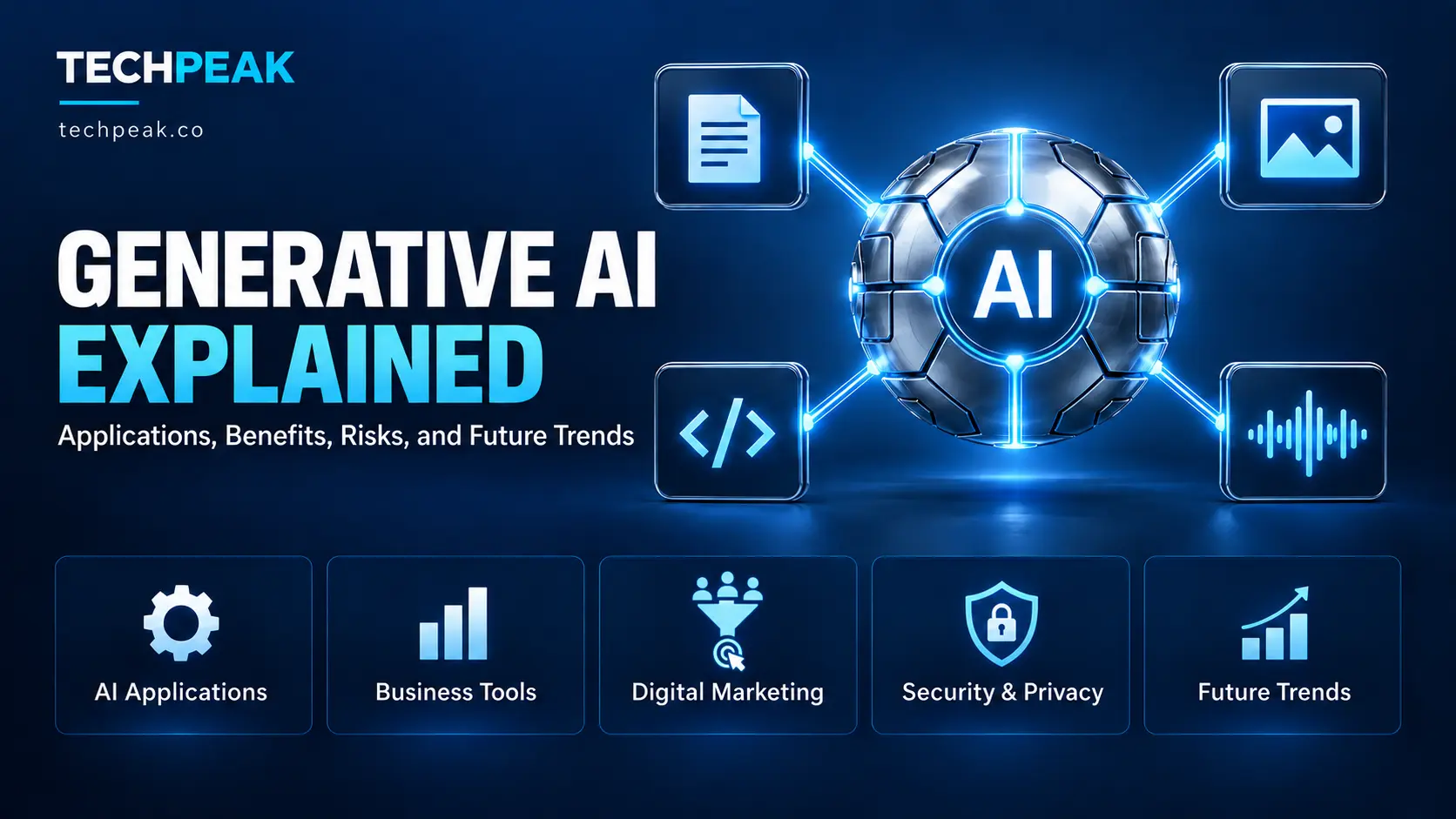
Generative artificial intelligence is a category of AI capable of producing new text, images, audio, video, software code, and other digital material in response to instructions or data. Unlike systems created only to classify information or predict a predefined outcome, generative models can construct original outputs based on patterns learned during training.
Businesses in the United States are using generative AI to draft documents, summarize research, develop software, assist customer-service teams, analyze business information, create marketing assets, and accelerate routine knowledge work. The technology can improve productivity and experimentation, but it can also produce false information, expose confidential data, reproduce bias, create security weaknesses, and generate material that raises copyright or ownership questions.
A responsible business should therefore treat generative AI as a powerful but imperfect tool. Human oversight, approved use cases, data controls, testing, and clear accountability remain essential.
Readers who need a broader foundation can first explore TechPeak’s complete guide to artificial intelligence. This sub-pillar focuses specifically on how generative AI works, where companies can use it, how to select appropriate tools, and how to manage its risks.
What Is Generative AI?
Generative AI is artificial intelligence designed to create new material based on patterns learned from training data. Depending on the model and application, the output may include:
- Written text
- Images and illustrations
- Audio and music
- Spoken dialogue
- Video
- Software code
- Product designs
- Data visualizations
- Three-dimensional models
- Synthetic datasets
A user commonly interacts with a generative AI system by entering a prompt. The prompt may contain a question, instruction, example, document, image, or combination of inputs. The system processes that information and generates a response based on its learned patterns and current configuration.
The result may appear human-created, but the model does not necessarily understand the subject in the same way a knowledgeable person does. It generates outputs through mathematical relationships learned from data. Consequently, a confident and well-written answer can still contain factual errors, invented sources, unsafe recommendations, or misleading conclusions.
What is a generative model?
A generative model learns aspects of how information is structured. Instead of only deciding which predefined label applies to an input, it estimates how to produce a new output that resembles patterns found in its training material.
Different model families are suited to different forms of generation:
- Large language models generate and transform text or code.
- Diffusion models are commonly used for images and increasingly for video.
- Transformer-based architectures process relationships within sequences and support many modern language and multimodal systems.
- Generative adversarial networks use competing neural networks and have historically been used for image and synthetic-data generation.
- Variational autoencoders learn compressed representations that can be used to create variations of data.
Many current products combine several techniques rather than relying on one isolated model.
How Does Generative AI Work?
Generative AI generally works through training, adaptation, prompting, inference, and evaluation.
1. Data preparation
Developers collect or obtain datasets that may include text, images, audio, code, video, or structured records. The data is processed into a form the model can use.
Data preparation may involve:
- Removing duplicates
- Filtering harmful or low-quality material
- Correcting formatting
- Dividing information into tokens or other units
- Labeling selected examples
- Removing certain personal information
- Documenting the source and permitted use of data
Data quality influences what the model learns. Incomplete, inaccurate, unrepresentative, or improperly obtained datasets can create performance, bias, privacy, and intellectual-property problems.
2. Model training
During training, the model adjusts a large number of numerical parameters to capture relationships in the data.
A language model may learn to predict a likely next token based on the preceding context. Repeating this process across very large datasets allows the model to learn grammar, associations, writing patterns, factual relationships, and some forms of reasoning behavior.
Training a model does not create a conventional database containing a clean copy of every fact. Knowledge is distributed across numerical parameters. Nevertheless, models can sometimes reproduce fragments of their training material, which creates privacy and copyright concerns.
3. Model adaptation
A general-purpose foundation model may be adapted for particular tasks through:
- Fine-tuning
- Instruction tuning
- Human feedback
- Preference optimization
- System instructions
- Retrieval-augmented generation
- Tool connections
- Organization-specific context
Retrieval-augmented generation, or RAG, allows an application to search approved documents or databases and provide relevant information to the model when producing an answer.
RAG can improve grounding and freshness, but it does not guarantee accuracy. The system may retrieve an irrelevant document, interpret it incorrectly, omit an important passage, or produce a claim unsupported by the retrieved source.
4. User prompting
The user supplies an instruction or input. A useful prompt may state:
- The task
- Intended audience
- Required context
- Desired format
- Constraints
- Source material
- Examples
- Review criteria
Clear prompts can improve results, but prompt quality cannot overcome every limitation in the model or source data.
5. Inference and output generation
Inference is the process of using a trained model to create a response.
The model evaluates the input and generates output one component at a time. Configuration settings can influence whether the output is more predictable or varied.
Because generation includes probabilistic selection, two responses to the same prompt may differ. Businesses should not assume that a previously successful prompt will always produce the same result.
6. Evaluation and human review
Outputs should be evaluated according to the risks associated with the task.
Review may include:
- Factual verification
- Source checking
- Security testing
- Bias assessment
- Privacy review
- Legal review
- Brand review
- Accessibility testing
- Human approval
A low-risk brainstorming task may need limited review. A healthcare, financial, employment, legal, security, or safety-related decision requires considerably stronger controls.
Generative AI vs. Traditional AI
Traditional AI and generative AI are related, but their primary functions differ.
| Area | Traditional or predictive AI | Generative AI |
|---|---|---|
| Main purpose | Classify, rank, detect, recommend, or predict | Produce new text, images, code, audio, or video |
| Typical input | Structured or unstructured data | Prompts, files, images, audio, data, or conversation |
| Typical output | Category, probability, forecast, or decision score | Newly generated content or transformed information |
| Example | Fraud detection | Drafting a fraud-investigation summary |
| Business role | Supports decisions and automation | Supports creation, communication, and knowledge work |
| Main concern | Incorrect classification or prediction | Incorrect, fabricated, unsafe, or infringing output |
Traditional AI might determine whether a bank transaction appears fraudulent. Generative AI could explain why the transaction was flagged or draft a case summary for an investigator.
A company may use both approaches in one system. Predictive AI can identify a risk, while generative AI converts the result into an explanation. The explanation must still be checked because a language model may introduce unsupported details.
Is machine learning the same as generative AI?
No. Machine learning is a broader field in which systems learn patterns from data. Generative AI is one category within that field.
Machine-learning systems can support:
- Forecasting
- Classification
- Recommendation
- Anomaly detection
- Computer vision
- Speech recognition
- Content generation
Not every machine-learning system generates content, and not every business problem requires a generative model.
Is generative AI the same as an AI agent?
Not necessarily. A basic generative model creates a response. An AI agent may combine a model with memory, tools, planning, permissions, and the ability to perform actions.
For example, an ordinary assistant may draft an email. An agent might retrieve customer information, draft the message, update a record, and schedule a follow-up.
The additional ability to act creates additional risk. Businesses must control which tools an agent can access, what information it can retrieve, and which actions require human approval.
Main Applications of Generative AI
Writing and document support
Generative AI can help employees:
- Draft reports
- Summarize long documents
- Rewrite technical explanations
- Prepare meeting notes
- Create outlines
- Translate content
- Generate initial proposals
- Adapt writing for different audiences
The model should support the author rather than silently replace accountability. The person publishing or sending the material remains responsible for its accuracy and suitability.
Research and knowledge retrieval
When connected to approved information, generative AI can help users find, summarize, and compare documents.
Potential uses include:
- Searching policy manuals
- Summarizing contracts
- Comparing product requirements
- Answering employee questions
- Reviewing customer feedback
- Extracting recurring themes
- Creating research briefs
Source citations and document access controls are important. A generated answer should not be treated as evidence unless the underlying material supports it.
Software development
Developers use generative AI to:
- Suggest code
- Explain unfamiliar functions
- Generate tests
- Refactor code
- Create documentation
- Identify possible errors
- Translate between programming languages
- Draft database queries
Generated code may contain vulnerabilities, incorrect dependencies, licensing concerns, or inefficient logic. It should undergo normal review, testing, security scanning, and approval.
Customer service
AI systems can:
- Draft replies
- Summarize customer histories
- Retrieve help-center information
- Classify requests
- Translate conversations
- Suggest troubleshooting steps
Companies should give customers a practical way to reach a person when the system cannot resolve an issue. High-impact account, billing, security, or eligibility decisions should not depend on an unchecked model response.
Product design and development
Teams may use generative AI to:
- Explore product ideas
- Produce interface concepts
- Draft user stories
- Create prototypes
- Summarize research
- Generate product descriptions
- Develop test scenarios
Generated concepts require validation with real users. Fast production does not prove that an idea is useful, accessible, technically feasible, or commercially viable.
Data analysis
Generative tools can translate questions into queries, explain charts, summarize patterns, or help analysts write code.
However, a persuasive narrative can conceal:
- Incorrect calculations
- Incomplete datasets
- Confounding variables
- Unsupported causal claims
- Misleading visualizations
Important analysis should be reproducible outside the conversational interface.
Education and training
Generative AI can create:
- Practice questions
- Individual explanations
- Simulations
- Role-playing exercises
- Training outlines
- Knowledge checks
- Course summaries
Training teams should verify accuracy and avoid entering confidential employee or customer data without authorization.
Creative production
Generative systems can help create:
- Images
- Illustrations
- Storyboards
- Audio
- Video concepts
- Advertising variations
- Product mockups
Creative teams need procedures for copyright, likeness, brand, licensing, disclosure, and quality review.
Benefits of Generative AI for Businesses
Faster first drafts
Generative AI can reduce the time required to move from an empty page to an initial draft. Employees can then spend more time reviewing, improving, and validating the material.
The benefit is strongest when the task is well-defined and a knowledgeable person can evaluate the result.
More accessible business knowledge
An approved AI assistant can help employees navigate policies, product documentation, and internal knowledge without knowing the exact location or terminology.
This requires controlled data access, reliable retrieval, source links, and permission-aware responses.
Greater content adaptability
A team can adapt one approved source into:
- An executive summary
- Customer FAQ
- Training document
- Social post
- Presentation outline
- Technical explanation
Every variation should preserve important facts, limitations, disclosures, and brand requirements.
Improved experimentation
Teams can create several concepts, messages, interface ideas, or code approaches quickly. This can widen the range of options considered before committing resources.
Generated options remain hypotheses. Customer research and testing must determine which option works.
Support for smaller teams
Small businesses may use AI to perform preliminary research, organize information, create first drafts, and automate low-risk administrative tasks.
The technology does not eliminate the need for professional expertise in law, finance, cybersecurity, healthcare, compliance, or other high-impact fields.
Improved accessibility
Generative tools can simplify language, produce captions, translate text, and provide alternative formats. Accessibility specialists and affected users should still review outputs because automated transformations can remove essential meaning or introduce barriers.
Best Generative AI Tools for U.S. Businesses
No single generative AI platform is best for every company. Products change frequently, so organizations should compare generative ai tools using current documentation and their own requirements.
General-purpose AI assistants
Platforms such as ChatGPT, Claude, Gemini, and Microsoft Copilot can support research, drafting, summarization, analysis, and workflow assistance.
Evaluate:
- Enterprise privacy terms
- Data-retention settings
- Administrative controls
- Identity integration
- Source citations
- File support
- Context limits
- Model availability
- Audit logs
- Regional availability
- Accessibility
- Pricing
- Contract terms
Workplace productivity tools
Microsoft 365 Copilot and Gemini for Google Workspace integrate generative capabilities into productivity suites.
They may help with documents, presentations, email, meetings, and spreadsheets. Their usefulness depends on data permissions, information quality, user training, licensing, and the company’s existing technology environment.
Creative tools
Adobe Firefly and other creative platforms can assist with images, design variations, video, and production workflows.
Review:
- Training-data representations
- Commercial-use terms
- Content credentials
- Output restrictions
- Likeness controls
- Brand management
- Intellectual-property indemnification, if offered
- Integration with existing workflows
Coding assistants
GitHub Copilot and similar tools can suggest code, explain functions, create tests, and support documentation.
Businesses should evaluate:
- Language support
- Code privacy
- Repository controls
- Security scanning
- Licensing safeguards
- Administrative features
- Development-environment integration
- Output quality on internal frameworks
Generated code must pass the same review and security requirements as manually written code.
Marketing-focused tools
Marketing platforms increasingly include AI for copy, personalization, customer segmentation, creative variations, and campaign analysis.
Choose tools based on:
- Data integration
- Brand controls
- Approval workflows
- Experiment design
- Attribution
- Privacy
- Accessibility
- Export options
- Total cost
Do not purchase a tool only because it advertises AI. Start with the marketing problem and determine whether generative technology materially improves the workflow.
Build or buy?
Buying an established tool may offer faster deployment, support, and predictable administration. Building a custom system may provide greater control over data, workflows, models, and integrations.
A custom solution also creates responsibility for:
- Architecture
- Security
- model evaluation
- Monitoring
- Updates
- Legal review
- Incident response
- Operational support
Many companies benefit from a combined approach: an enterprise platform for general productivity and controlled custom applications for specialized workflows.
How to Evaluate a Generative AI Tool
Use a documented scorecard rather than relying on a demonstration.
Business fit
Ask:
- Which problem does the tool solve?
- Who will use it?
- What process will change?
- What measurable outcome should improve?
- What happens if the tool is unavailable?
- Does a simpler technology already solve the problem?
Output quality
Test the tool using representative tasks. Evaluate:
- Accuracy
- Completeness
- Consistency
- Source grounding
- Instruction following
- Refusal behavior
- Bias
- Accessibility
- Performance with unusual inputs
Vendor benchmarks may not represent an organization’s actual work.
Data protection
Determine:
- What information the vendor collects
- Whether prompts train models
- Where data is stored
- How long data is retained
- Which subcontractors receive data
- Whether administrators can manage retention
- Whether data can be deleted or exported
- Which contractual protections apply
Security
Evaluate:
- Authentication
- Role-based access
- Encryption
- Audit logs
- Incident notification
- Model and application isolation
- Data-loss prevention
- Integration permissions
- Vulnerability management
- Security documentation
Governance
The platform should support the organization’s approval, monitoring, recordkeeping, and review requirements.
Cost
Include:
- Licenses
- API usage
- Computing
- Storage
- Integration
- Training
- Security
- Administration
- Monitoring
- Human review
- Vendor support
- Switching costs
A low per-user price can produce a high total cost when the tool adds overlapping licenses or requires extensive review.
How Generative AI Is Changing Digital Marketing
Generative AI is changing how marketers research audiences, produce content, create advertisements, personalize messages, analyze campaigns, and manage customer interactions.
Content production
AI can support:
- Topic research
- Content briefs
- Outlines
- First drafts
- Headline alternatives
- Summaries
- Email variations
- Social-media copy
- Product descriptions
Marketers should not publish unchecked output. AI may invent facts, misrepresent products, omit disclosures, repeat stereotypes, or produce generic language.
Search marketing
Generative AI can help organize keywords, classify intent, identify content gaps, create structured data drafts, and summarize search-performance information.
It should not be used to produce thousands of near-duplicate pages. Search visibility still depends on useful, original, trustworthy, accessible, and technically sound content.
Advertising
AI can generate creative variations, suggest audience segments, and assist with campaign analysis.
Human reviewers must confirm that advertisements do not contain:
- Unsupported claims
- Discriminatory targeting
- Fake testimonials
- Incorrect prices
- Missing disclosures
- Inappropriate imagery
- Misleading urgency
Personalization
Generative systems can tailor content based on customer context. Personalization should remain within reasonable expectations and applicable privacy requirements.
Do not expose sensitive inferences or create messages that appear manipulative, intrusive, or discriminatory.
Customer experience
AI can help answer questions and guide customers through products. Businesses should disclose automated interaction where appropriate and provide a route to human support.
AEO and GEO
Generative search and answer systems increase the importance of:
- Clear definitions
- Direct answers
- Strong entity information
- Primary sources
- Original research
- Consistent facts
- Visible authorship
- Transparent methodology
- Updated content
GEO does not mean writing for machines at the expense of readers. Information that is accurate, structured, well-supported, and easy for people to understand is also easier for automated systems to interpret.
Generative AI Security Risks
NIST’s Generative AI Profile supplements the AI Risk Management Framework with considerations specific to generative systems. It is intended to help organizations incorporate trustworthiness into the design, development, use, and evaluation of AI systems. NIST Generative AI Profile
Prompt injection
Prompt injection occurs when malicious or untrusted instructions influence the model’s behavior.
An attacker may place instructions inside:
- A web page
- Document
- Database entry
- Retrieved knowledge source
- Tool response
A connected AI system might follow those instructions instead of the organization’s intended rules.
Controls may include:
- Separating trusted and untrusted instructions
- Limiting tool permissions
- Filtering retrieved content
- Requiring approval for sensitive actions
- Monitoring unusual behavior
- Testing adversarial inputs
Confidential-data exposure
Employees may paste customer records, source code, contracts, credentials, or strategic information into tools that are not approved for that data.
Use:
- Approved-tool lists
- Data-classification rules
- Technical restrictions
- Employee training
- Enterprise privacy configurations
- Data-loss prevention
- Logging appropriate to the risk
Insecure generated code
AI-generated code may contain vulnerabilities, outdated libraries, exposed secrets, or insecure configurations.
Require:
- Peer review
- Automated testing
- Dependency scanning
- Secret detection
- Static analysis
- Secure-development practices
Excessive permissions
AI agents become more dangerous when they can send messages, alter records, execute code, transfer money, or access large data collections.
Apply least privilege and require human authorization for consequential actions.
Model and supply-chain risk
Generative applications may depend on model providers, open-source components, plugins, APIs, vector databases, and external data.
Maintain:
- Component inventories
- Vendor reviews
- Version controls
- Access restrictions
- Update procedures
- Incident plans
- Exit strategies
Synthetic media and impersonation
Generative systems can create convincing fake text, voices, images, and videos.
Businesses should:
- Protect executive and brand identities
- Establish verification procedures
- Train employees about impersonation
- Monitor high-risk channels
- Prepare fraud-response processes
- Use content-origin information where appropriate
Generative AI Privacy Risks
Personal information in prompts
Prompts may contain names, contact information, health data, employment records, financial details, or confidential communications.
Employees need clear rules about what data may be entered and which approved systems may process it.
Training-data privacy
Models can be trained on large datasets containing personal or sensitive information. Organizations developing or fine-tuning systems should document data provenance, authority to use it, retention, and removal procedures.
Unexpected inference
A model may infer sensitive characteristics from seemingly ordinary information. Businesses should review whether an inference is necessary, accurate, fair, and appropriate.
Memorization
Models may sometimes reproduce parts of training or fine-tuning data. Avoid training on secrets or unnecessary personal data, and test systems for unintended disclosure.
Conversation retention
Review whether chats are retained, who can access them, and whether administrators can control retention and deletion.
Privacy notices should describe actual practices rather than making broad statements that the system cannot support.
Accuracy, Hallucinations, and Bias
A hallucination is output that appears plausible but is false or unsupported.
Models may invent:
- Facts
- Statistics
- Quotations
- Legal cases
- Citations
- Product features
- People
- Events
Hallucinations are especially dangerous when users trust confident language.
Controls include:
- Providing authoritative source material
- Requiring citations
- Checking cited passages
- Restricting tasks
- Using structured outputs
- Testing known questions
- Keeping humans responsible for approval
Bias can enter through training data, labeling, system design, evaluation, deployment context, or user behavior.
Test performance across relevant groups and situations. A model performing well on average may still fail disproportionately for particular users.
Copyright and Intellectual-Property Issues
Generative AI raises questions involving training data, output authorship, copyrighted elements, trademarks, confidential information, and rights of publicity.
The U.S. Copyright Office maintains an ongoing initiative examining artificial intelligence, including digital replicas, copyrightability, and the use of copyrighted material in AI training. Businesses should consult current guidance rather than assuming that every AI output receives copyright protection or that every generated asset is safe to use. U.S. Copyright Office AI initiative
Practical controls include:
- Recording which tool and account created an asset
- Retaining important prompts and source files
- Documenting human creative contribution
- Checking outputs for recognizable protected material
- Reviewing vendor terms
- Obtaining permission for names and likenesses
- Avoiding requests to imitate living artists
- Conducting legal review for important commercial uses
How Companies Can Create a Generative AI Policy
A generative AI policy should be practical enough for employees to use. A policy that only says “use AI responsibly” gives little direction.
1. Define the purpose
Explain why the organization permits generative AI and which business goals it may support.
2. Define approved and prohibited uses
Approved uses might include:
- Brainstorming
- Internal summaries
- Low-risk drafts
- Code explanation
- Meeting preparation
Restricted or prohibited uses may include:
- Entering confidential data into unapproved tools
- Making final hiring decisions
- Generating deceptive content
- Impersonating people
- Providing unreviewed professional advice
- Taking consequential actions without authorization
3. Classify data
State which data categories may be used with each approved tool.
Distinguish:
- Public
- Internal
- Confidential
- Restricted
- Regulated
4. Require human accountability
Identify who approves AI-generated content and decisions. “The AI produced it” is not an acceptable explanation for publishing false information or taking an improper action.
5. Establish verification requirements
Define when employees must:
- Check facts
- Inspect sources
- Test code
- Review for bias
- Obtain legal approval
- Obtain security approval
- Disclose AI assistance
6. Address intellectual property
Explain acceptable use of copyrighted material, trademarks, customer content, proprietary information, and generated assets.
7. Control integrations and agents
Require approval before connecting AI to:
- Customer databases
- Financial systems
- Code repositories
- Cloud storage
- Administrative tools
8. Establish incident reporting
Employees should know how to report:
- Sensitive-data exposure
- Harmful output
- Security issues
- Copyright concerns
- Discriminatory results
- Unauthorized tools
- Incorrect customer communications
9. Train employees
Training should use examples from actual work. Include prompt handling, data classification, verification, security, copyright, and escalation.
10. Review the policy regularly
Update the policy when tools, contracts, laws, risks, or business uses change.
A Practical Generative AI Implementation Plan
1st Phase: Discover
- Inventory existing AI use.
- Identify business problems.
- Classify relevant data.
- Interview employees.
- Review security and compliance requirements.
- Define measurable outcomes.
2nd Phase: Select
- Compare approved vendors.
- Test representative tasks.
- Review contracts and privacy terms.
- Evaluate accessibility.
- Calculate total cost.
- Create an exit strategy.
3rd Phase: Pilot
Choose a useful but limited use case. Define:
- Eligible users
- Approved data
- Success criteria
- Human review
- Incident procedures
- Pilot duration
Phase 4: Evaluate
Measure:
- Output accuracy
- Time saved
- Work quality
- Adoption
- Error rate
- Review time
- Security events
- User satisfaction
- Business value
Phase 5: Scale
Expand only after the pilot meets defined standards. Provide training, monitoring, support, version management, and regular reevaluation.
The Future of Generative AI in the United States
The future of generative AI will be shaped by model development, business adoption, computing infrastructure, workforce skills, security, copyright, and government policy.
The July 2025 White House AI Action Plan organizes federal priorities around accelerating innovation, building AI infrastructure, and strengthening international leadership and security. It also discusses AI adoption, workforce skills, evaluations, secure-by-design technology, incident response, open-weight models, compute, data centers, and energy infrastructure. America’s AI Action Plan
More multimodal systems
AI products will increasingly work across text, images, audio, video, data, and software interfaces within one experience.
Smaller and specialized models
Businesses may use smaller models designed for particular industries or internal tasks. These can offer advantages in cost, speed, privacy, and control.
Growth of AI agents
AI systems will increasingly perform multistep work through connected tools. This will increase the importance of permissions, monitoring, reliable evaluations, and human approval.
Increased use of internal knowledge
Companies will connect models to approved internal information. Permission-aware retrieval, document quality, and source transparency will become essential.
More AI infrastructure
Demand for computing, data centers, chips, energy, networking, and skilled workers will continue to influence the U.S. AI market.
Greater emphasis on evaluation
Companies will need evidence that AI systems work reliably for their actual tasks. General benchmarks will be supplemented by organization-specific testing.
Changing jobs and skills
Generative AI is more likely to transform collections of tasks than to affect every job identically. Employees will need skills in verification, domain judgment, workflow design, data handling, and AI supervision.
Continuing policy development
Federal and state approaches may continue evolving. Businesses operating across jurisdictions should monitor current requirements and avoid relying on outdated summaries.
Persistent human responsibility
Models may become more capable, but organizations will remain responsible for how they select, configure, deploy, monitor, and use them.
Conclusion
Generative AI can create text, images, audio, video, code, and other content while helping businesses search information, automate routine work, serve customers, develop products, and improve marketing.
Its value depends on more than model capability. Organizations need suitable use cases, reliable data, secure systems, clear policies, trained employees, meaningful evaluation, and accountable human oversight.
The right question is not simply whether a company should adopt generative AI. It is where the technology produces measurable value, what risks it introduces, and which controls allow the organization to use it responsibly.
Frequently Asked Questions
What is generative AI in simple terms?
Generative AI is artificial intelligence that creates new text, images, audio, video, software code, or other material based on patterns learned from data.
How does generative AI work?
A generative model learns statistical relationships from training data and uses those patterns to produce an output in response to a prompt or other input.
What is the difference between generative AI and traditional AI?
Traditional AI commonly classifies information or predicts outcomes. Generative AI produces new content. Many business systems combine both approaches.
What are examples of generative AI tools?
Examples include general AI assistants, workplace copilots, coding assistants, creative platforms, and specialized enterprise applications. Features and terms change, so businesses should review current vendor documentation.
What are the main benefits of generative AI?
Potential benefits include faster drafting, easier access to knowledge, improved experimentation, adaptable content, software-development support, and automation of selected routine tasks.
What are the biggest generative AI risks?
Important risks include hallucinations, confidential-data exposure, prompt injection, biased outputs, insecure code, privacy violations, copyright concerns, impersonation, and excessive automation.
Can generative AI replace employees?
It can automate or change particular tasks, but its effect varies by job, industry, workflow, and organization. Human expertise remains necessary for judgment, verification, accountability, and high-impact decisions.
Can businesses enter confidential information into generative AI?
Only when the organization has approved the tool and data category, reviewed the relevant terms and controls, and authorized the particular use.
Is AI-generated content copyrighted?
Copyright protection depends on applicable law and the nature of human authorship. Businesses should review current U.S. Copyright Office guidance and obtain legal advice for important uses.
Does a company need a generative AI policy?
A policy is strongly recommended when employees use AI for business. It should define approved tools, permitted data, prohibited uses, review requirements, accountability, security, and incident reporting.
How should a business select a generative AI tool?
Compare business fit, output quality, privacy, security, integrations, administration, accessibility, portability, contract terms, and total cost using representative tests.
What is the future of generative AI?
Likely developments include multimodal models, specialized models, AI agents, greater use of internal knowledge, expanded infrastructure, stronger evaluations, and continuing changes in work and public policy.

1 Comment
Pingback: Artificial Intelligence Guide for Business and Consumers