

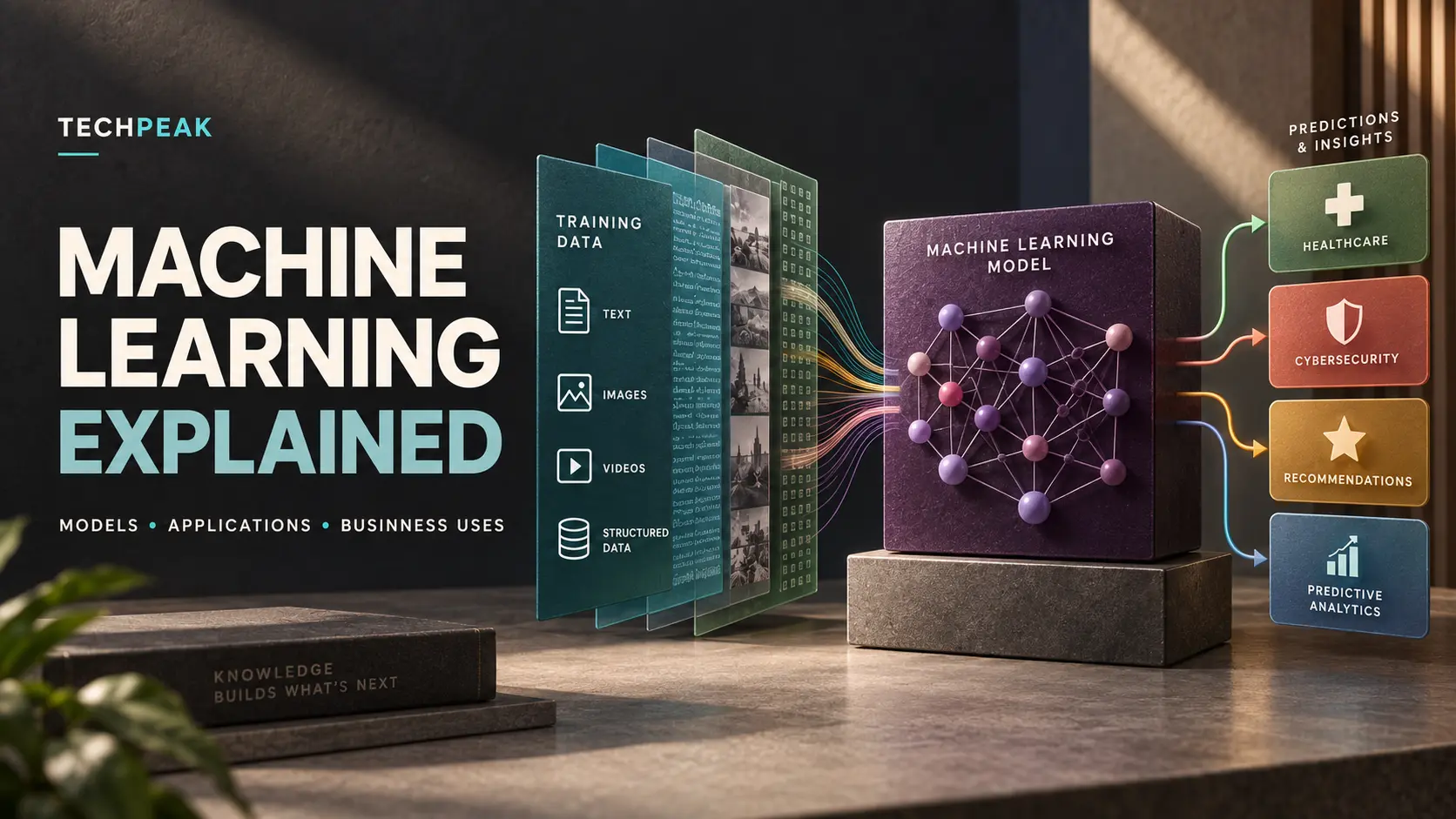
Machine learning is a branch of artificial intelligence that enables computer systems to identify patterns in data and use those patterns to make predictions, classifications, recommendations, or other decisions.
Instead of programming every possible condition manually, developers give a machine learning system examples or historical data. The system uses an algorithm to discover mathematical relationships within that data. Those learned relationships form a model that can be applied to new information.
A retailer might use machine learning to forecast product demand. A bank could use it to identify unusual transactions. A healthcare organization may use it to support image analysis or predict operational demand. A streaming platform can use it to recommend content based on viewer behavior.
Machine learning can produce significant business value, but it is not automatic intelligence. A model is only one component of a larger system involving data collection, business rules, software integrations, testing, security, human decisions, and continuous monitoring.
Quick answer: Machine learning is a method through which software learns statistical patterns from data instead of relying only on explicitly programmed rules. Businesses use machine learning for forecasting, personalization, fraud detection, recommendation systems, document analysis, cybersecurity, customer segmentation, and decision support.
For a broader explanation of AI technologies and their organizational impact, read TechPeak’s complete artificial intelligence guide. That parent resource explains how machine learning fits into the wider AI landscape alongside generative AI, automation, computer vision, natural language processing, and other technologies.
What Is Machine Learning?
Machine learning is the process of training a mathematical or computational model to recognize useful relationships in data.
The model receives input variables, sometimes called features. During training, an algorithm adjusts the model to produce results that correspond as closely as possible to known examples or useful statistical patterns.
After training, the model can process new data that it has not previously encountered.
For example, a business may have historical records showing:
- Customer characteristics.
- Products viewed.
- Previous purchases.
- Support interactions.
- Account age.
- Subscription status.
- Whether each customer ultimately canceled.
A machine learning model could analyze those records to estimate the probability that a current customer will cancel. The business might then use that prediction to prioritize retention outreach.
The prediction is not a certainty. It is a probability or model-generated estimate based on relationships found in the training data.
A simple machine learning example
Suppose an equipment-maintenance company wants to predict whether a machine is likely to fail within 30 days.
The input features might include:
- Machine age.
- Operating hours.
- Temperature readings.
- Vibration measurements.
- Recent error codes.
- Maintenance history.
- Environmental conditions.
Historical records indicate which machines failed and which continued operating. The model learns associations between the measurements and previous failures.
When new measurements arrive, the trained model generates a failure-risk score. A maintenance manager can use that score alongside inspection records and professional judgment to prioritize equipment.
Machine learning does not physically inspect or repair the machine. It supports a specific decision within a broader operational process.
How Does Machine Learning Work?
A machine learning project generally moves through a lifecycle rather than a single training event.
1. Define the business problem
The organization identifies a decision or result that could be improved.
Examples include:
- Which customers are likely to cancel?
- How many units of a product will be required next month?
- Is a transaction unusually risky?
- Which products are most relevant to a visitor?
- Which maintenance requests require immediate attention?
The problem must be measurable. “Use machine learning to improve sales” is too broad. “Increase qualified product recommendations without increasing the product-return rate” is more useful.
2. Collect relevant data
Data may come from:
- Business applications.
- Customer relationship management systems.
- Transaction databases.
- Sensors.
- Website analytics.
- Customer-support platforms.
- Documents.
- Images.
- Public datasets.
- Licensed third-party sources.
The organization must have a lawful and appropriate basis for collecting and using the information.
3. Prepare the data
Teams correct formatting problems, remove inappropriate duplicates, handle missing values, define labels, identify unusual records, and combine relevant sources.
This stage often requires more effort than model training because real business data was usually created for operational purposes rather than machine learning.
4. Select and engineer features
Features are the inputs the model uses.
For a sales forecast, possible features might include:
- Historical sales.
- Day of the week.
- Season.
- Promotion status.
- Price.
- Location.
- Inventory availability.
- Recent demand trend.
Feature engineering converts raw data into variables that better represent the business problem. Modern deep-learning systems can learn some useful representations automatically, but data design and domain knowledge remain important.
5. Divide the dataset
A common approach separates available data into:
- Training data: Used to fit the model.
- Validation data: Used to compare configurations and tune the model.
- Test data: Used to estimate performance on unseen examples.
The test set should not influence model selection. Otherwise, the reported result may be unrealistically optimistic.
6. Train the model
The selected algorithm adjusts internal parameters to reduce error or improve an objective.
Training may range from fitting a small regression equation to optimizing millions or billions of parameters in a neural network.
7. Evaluate performance
Evaluation depends on the business task. Possible metrics include:
- Accuracy.
- Precision.
- Recall.
- F1 score.
- Area under the receiver operating characteristic curve.
- Mean absolute error.
- Root mean squared error.
- Mean absolute percentage error.
- Ranking quality.
- Calibration.
- False-positive and false-negative rates.
No single metric is best for every problem. A fraud model that labels every transaction as legitimate might achieve high overall accuracy if fraud is rare, yet fail at its actual purpose.
8. Deploy the model
A validated model may be added to:
- A business application.
- An API.
- An analytics dashboard.
- A batch-processing workflow.
- A customer-facing product.
- A decision-support interface.
- An automated business process.
9. Monitor and retrain
Model performance can decline as customer behavior, market conditions, equipment, source systems, or data definitions change.
Organizations should monitor:
- Input-data changes.
- Prediction distributions.
- Accuracy when outcomes become available.
- Performance across relevant groups.
- Latency and system reliability.
- Operational costs.
- Employee corrections.
- Business outcomes.
- Security events.
Machine Learning vs. Artificial Intelligence
Artificial intelligence and machine learning are related but not identical.
Artificial intelligence is the broader field concerned with computer systems that perform tasks associated with human intelligence, such as perception, language interpretation, reasoning, planning, and decision-making.
Machine learning is a set of methods within artificial intelligence that learns patterns from data.
A system can use artificial intelligence without relying primarily on machine learning. Earlier AI systems often used explicitly programmed rules, knowledge bases, and logical reasoning. Conversely, many modern AI products depend heavily on machine learning.
| Area | Artificial intelligence | Machine learning |
|---|---|---|
| Scope | Broad field of intelligent computer behavior | Subfield of AI focused on learning from data |
| Primary objective | Perform tasks involving perception, reasoning, language, planning, or decisions | Learn patterns that support predictions or classifications |
| Possible methods | Rules, search, planning, optimization, machine learning and knowledge representation | Regression, decision trees, clustering, neural networks and related algorithms |
| Data requirement | Varies by technique | Usually requires representative data |
| Example | Rule-based scheduling assistant | Model that predicts scheduling demand |
| Business role | Describes the overall intelligent system | Often provides a predictive or interpretive component |
Is generative AI the same as machine learning?
No. Generative AI is a category of AI that creates new material, such as text, images, audio, video, or code. Modern generative systems are built using machine learning, frequently with large neural networks.
Traditional predictive machine learning commonly estimates a category, value, risk, or probability. Generative AI produces new output based on patterns learned from large datasets.
A company might use:
- Predictive machine learning to estimate customer churn.
- Generative AI to draft a retention email.
- Workflow automation to send the draft for approval.
- Business software to record the final interaction.
These technologies can operate together while performing different roles.
Types of Machine Learning
The four commonly discussed learning approaches are supervised, unsupervised, semi-supervised or self-supervised learning, and reinforcement learning.
Supervised vs. Unsupervised Machine Learning
The principal difference is whether the training examples contain a known answer.
What is supervised machine learning?
Supervised learning trains a model using labeled examples. Each example includes input data and a known target.
Examples include:
- A message labeled as spam or legitimate.
- A transaction labeled as fraudulent or valid.
- A property record with a known sale price.
- A customer record showing whether the customer canceled.
- A medical image associated with a confirmed clinical finding.
The model learns a relationship between the inputs and the label. It can then estimate a label or value for a new example.
Supervised learning is commonly used for classification and regression.
Classification
Classification predicts a category.
Examples include:
- Fraud or not fraud.
- Customer likely to cancel or remain.
- Product belongs in category A, B, or C.
- Support request is billing, technical, sales, or another type.
- Image contains a particular object or does not.
A model may generate both a predicted class and a confidence or probability score.
Regression
Regression predicts a numeric value.
Examples include:
- Expected monthly sales.
- Delivery time.
- Customer lifetime value.
- Energy consumption.
- Repair cost.
- Product demand.
What is unsupervised machine learning?
Unsupervised learning analyzes data without a predefined target label. The system searches for structure, similarity, groups, or unusual patterns.
Common uses include:
- Customer segmentation.
- Document grouping.
- Product grouping.
- Pattern discovery.
- Dimensionality reduction.
- Anomaly detection.
- Exploratory analysis.
A clustering algorithm, for example, might separate customers into groups based on buying behavior. The model does not automatically know that one group represents “budget-focused buyers.” A business analyst must examine the group and interpret its meaning.
Supervised and unsupervised learning compared
| Factor | Supervised learning | Unsupervised learning |
|---|---|---|
| Training data | Contains known labels or outcomes | Does not contain a target outcome |
| Objective | Predict an answer for new examples | Discover structure or patterns |
| Common tasks | Classification and regression | Clustering, association and dimensionality reduction |
| Example | Predict whether a customer will cancel | Identify behavioral customer segments |
| Evaluation | Compare predictions with known results | Use statistical measures and business interpretation |
| Main challenge | Obtaining accurate, representative labels | Determining whether discovered patterns are meaningful |
What is semi-supervised learning?
Semi-supervised learning uses a smaller amount of labeled data together with a larger amount of unlabeled data.
This can be useful when raw examples are easy to obtain but expert labeling is expensive. A company may have thousands of documents but only a limited number classified by trained reviewers.
What is self-supervised learning?
Self-supervised learning creates training objectives from the structure of the data itself. Rather than requiring a person to label every example, the system predicts hidden or transformed parts of the input.
Many modern language, vision, and multimodal models use self-supervised learning during their initial training.
What is reinforcement learning?
Reinforcement learning trains an agent through interaction with an environment. The agent takes actions and receives rewards or penalties.
Potential applications include:
- Robotics.
- Dynamic resource allocation.
- Game-playing systems.
- Traffic control.
- Some recommendation and advertising decisions.
- Industrial process optimization.
Reinforcement learning can be difficult to use safely in business because an poorly specified reward may encourage unintended behavior.
Common Machine Learning Models
A model should be selected according to the problem, data, performance requirements, interpretability needs, and operational environment.
| Model or technique | Common use | Principal advantage | Important limitation |
|---|---|---|---|
| Linear regression | Predicting numeric values | Simple and interpretable | May miss nonlinear relationships |
| Logistic regression | Binary classification | Interpretable probability estimates | Limited when relationships are highly complex |
| Decision tree | Classification and regression | Easy to visualize | Individual trees can overfit |
| Random forest | Classification and regression | Handles complex relationships and mixed features | Less interpretable than one decision tree |
| Gradient-boosted trees | Structured business data | Often performs strongly on tabular data | Requires careful tuning and monitoring |
| Support vector machine | Classification | Effective in some high-dimensional problems | Can be expensive on very large datasets |
| Nearest-neighbor model | Similarity and classification | Intuitive and easy to understand | Prediction can become slow with large datasets |
| Neural network | Images, language, audio and complex patterns | Learns sophisticated representations | Data- and compute-intensive; less transparent |
| Clustering | Segmentation and pattern discovery | Does not require labels | Groups may not have practical meaning |
| Anomaly-detection model | Fraud, security and equipment monitoring | Helps surface unusual activity | Unusual does not necessarily mean harmful |
| Time-series model | Forecasting over time | Represents seasonality and temporal patterns | Sudden structural changes can reduce reliability |
| Recommendation model | Ranking products or content | Personalizes discovery | Cold-start, feedback-loop and bias challenges |
Does a more complex model perform better?
Not necessarily.
A complex model may fit subtle patterns but can be harder to explain, maintain, test, and operate. It may also learn irrelevant correlations or require more data than the organization possesses.
Businesses should begin with an understandable baseline. A complex model is justified when it produces a meaningful improvement under realistic testing and the organization can manage its additional operational risk.
Machine Learning Model Evaluation
A model should be evaluated against its business consequences, not merely its technical score.
Accuracy
Accuracy is the proportion of predictions that are correct.
It is most useful when classes are reasonably balanced and errors have similar consequences.
Precision
Precision asks:
Of the examples predicted as positive, how many were actually positive?
High precision is important when false alarms are costly.
Recall
Recall asks:
Of all actual positive examples, how many did the model identify?
High recall matters when missing a positive case is dangerous or expensive.
F1 score
The F1 score combines precision and recall. It can be useful when the classes are imbalanced and both types of error matter.
False positives and false negatives
The business must examine each type of error separately.
In cybersecurity:
- A false positive may waste an analyst’s time.
- A false negative may allow a genuine attack to proceed.
In healthcare:
- A false positive may cause unnecessary testing or anxiety.
- A false negative may delay needed care.
The appropriate tradeoff depends on the application and must involve domain experts.
Calibration
A model is calibrated when its predicted probabilities correspond reasonably well with actual outcomes.
If a model assigns 70% risk to 100 similar cases, approximately 70 of those cases should experience the outcome over time.
Calibration is particularly important when people use a model score to make prioritization or resource-allocation decisions.
Performance by subgroup
Overall performance can conceal poor results for particular populations, locations, customer types, device types, or operating conditions.
Organizations should test relevant subgroups where legally, ethically, and statistically appropriate.
How Businesses Prepare Data for Machine Learning
Data preparation is the foundation of an effective machine learning project. Sophisticated algorithms cannot compensate for irrelevant, incomplete, or misleading data.
Define the prediction point
Teams must establish the exact moment at which a prediction will be produced.
If a model predicts customer cancellation at the beginning of a month, it cannot use information generated after that date. Including future information creates data leakage and produces unrealistic testing results.
Identify authoritative data sources
The organization should document:
- Where each field originates.
- Who owns the source system.
- How often it changes.
- Whether historical values are preserved.
- What the field actually means.
- Which users or systems can modify it.
Two systems may use the same field name while storing different concepts.
Profile the data
Data profiling examines:
- Missing values.
- Duplicate records.
- Invalid values.
- Inconsistent categories.
- Unusual distributions.
- Outliers.
- Time coverage.
- Label frequency.
- Changes in collection methods.
This step can reveal that the available dataset does not adequately represent the intended population or operating environment.
Clean data carefully
Cleaning may involve:
- Standardizing dates and units.
- Correcting encoding problems.
- Resolving duplicate entities.
- Handling missing values.
- Normalizing category names.
- Removing invalid records.
- Correcting proven data-entry errors.
Teams should not automatically delete every unusual record. An apparent outlier may represent an important rare event, a new customer type, fraud, equipment failure, or another case the model needs to recognize.
Create reliable labels
Labels must accurately represent the outcome being predicted.
A poorly defined label can cause a model to solve the wrong problem. For example, “customer contacted support” is not necessarily an accurate label for “customer experienced a product problem,” because many affected customers never open a ticket.
Avoid data leakage
Leakage occurs when training data contains information that would not be available when the real prediction is made.
Examples include:
- Using the final payment status to predict whether an invoice will be late.
- Using post-diagnosis information to predict a diagnosis.
- Randomly splitting time-dependent records so future behavior appears in training data.
- Including a field created directly from the target outcome.
Leakage can produce impressive test results followed by poor production performance.
Handle class imbalance
Many valuable outcomes are rare. Fraud, equipment failure, account takeover, and serious medical conditions may represent a small fraction of examples.
Teams can use:
- Appropriate evaluation metrics.
- Class weighting.
- Careful resampling.
- Threshold adjustment.
- Anomaly-detection techniques.
- Additional data collection.
Artificially balancing a training set does not change the real-world frequency of the event. Final evaluation should reflect expected operating conditions.
Protect sensitive information
Data preparation should include:
- Data minimization.
- Access controls.
- Encryption.
- Retention limits.
- De-identification or pseudonymization when appropriate.
- Contractual restrictions.
- Audit logging.
- Legal and compliance review.
Removing obvious names does not guarantee that a dataset is anonymous. Combinations of attributes can sometimes identify an individual.
Document the dataset
Documentation should describe:
- Intended purpose.
- Collection period.
- Source systems.
- Included and excluded populations.
- Known limitations.
- Labeling procedures.
- Missing-data patterns.
- Transformations.
- Access restrictions.
- Approved uses.
- Version history.
Machine Learning Applications in Healthcare
Machine learning has applications across clinical care, medical research, administration, operations, and medical-device software. The level of risk and regulatory scrutiny depends on the intended use.
Medical imaging
Models can assist with detecting or measuring patterns in:
- X-rays.
- CT scans.
- MRI scans.
- Ultrasound.
- Retinal images.
- Pathology slides.
- Dermatological images.
The system may identify areas for review, segment anatomical structures, measure changes, or prioritize cases.
These tools should be evaluated within the complete clinical workflow, including the interaction between the model and healthcare professionals.
Clinical decision support
Machine learning may help estimate:
- Risk of deterioration.
- Hospital readmission.
- Treatment complications.
- Disease progression.
- Medication-related risk.
- Need for additional assessment.
A risk score does not establish a diagnosis. Clinicians require appropriate context, limitations, and evidence.
Operational forecasting
Healthcare organizations may use machine learning to predict:
- Patient volume.
- Staffing requirements.
- Appointment cancellations.
- Bed demand.
- Supply usage.
- Scheduling bottlenecks.
- Equipment maintenance needs.
These operational applications can be valuable without directly diagnosing or treating a patient.
Drug discovery and research
Machine learning may help researchers identify molecular patterns, prioritize candidates, analyze scientific literature, or examine complex datasets. Laboratory and clinical validation remain essential.
Billing and administration
Possible uses include:
- Document classification.
- Coding assistance.
- Claims review.
- Prior-authorization workflow support.
- Scheduling.
- Call routing.
- Payment anomaly detection.
U.S. healthcare considerations
The FDA maintains a list of AI-enabled medical devices authorized for marketing in the United States. The agency explains that the list supports transparency and helps stakeholders understand the medical-device landscape, although inclusion should not be interpreted as endorsement of every use outside the authorized context.
FDA-related good machine learning practice emphasizes safe, effective development across the medical-device product lifecycle. Current principles address matters such as representative datasets, independent test sets, human-AI team performance, clear user information, and ongoing monitoring.
Healthcare organizations should distinguish between:
- An internal operational forecast.
- General wellness software.
- Clinical decision support.
- Software functioning as a medical device.
- AI embedded within a physical medical device.
The intended use, claims, functionality, and regulatory context determine the applicable requirements. Healthcare organizations should obtain qualified regulatory, privacy, security, and clinical advice.
Machine Learning Applications in Cybersecurity
Machine learning helps cybersecurity teams analyze volumes of activity that would be difficult to review manually. It can identify patterns, rank alerts, and recognize behavior that differs from an established baseline.
Anomaly detection
A model can identify unusual:
- Login behavior.
- Network traffic.
- Data transfers.
- Device activity.
- Administrative actions.
- Resource usage.
- Authentication patterns.
An anomaly is not automatically an attack. It is an event that deserves additional analysis.
Malware and file analysis
Machine learning can analyze file properties, behavioral signals, or execution patterns to help identify potentially malicious software.
Attackers can change techniques, so model results should supplement other detection methods, threat intelligence, sandboxing, and expert analysis.
Phishing detection
Models can evaluate:
- Message content.
- Sender characteristics.
- Link patterns.
- Domain information.
- Attachment properties.
- Communication behavior.
Generative AI can make malicious messages more natural, increasing the importance of layered email security and user awareness.
Account takeover and identity risk
Machine learning can combine signals such as:
- New devices.
- Unusual locations.
- Impossible travel.
- Abnormal login times.
- Repeated authentication failures.
- Changes in transaction behavior.
A risk score can trigger additional authentication or analyst review.
Security alert prioritization
Security operations centers frequently receive more alerts than analysts can investigate immediately. Machine learning can rank alerts based on severity, context, historical outcomes, and affected assets.
The system should not silently discard lower-ranked alerts without an approved policy and monitoring.
Security risks affecting machine learning systems
Machine learning introduces its own attack surface:
- Training-data poisoning.
- Maliciously modified labels.
- Adversarial inputs.
- Model extraction.
- Sensitive-data leakage.
- Insecure model files.
- Compromised software dependencies.
- Unauthorized access to model endpoints.
- Manipulation of monitoring data.
CISA’s broader AI work emphasizes both the use of AI in cyber defense and the importance of securing AI systems and critical infrastructure.
Businesses should combine machine learning with established cybersecurity controls, not use it as a replacement for identity management, patching, network segmentation, backups, incident response, and human expertise.
How Recommendation Engines Work
A recommendation engine predicts which products, content, services, or actions are most relevant to a user or context.
Recommendation systems are used by:
- Ecommerce stores.
- Streaming services.
- News platforms.
- Online marketplaces.
- Learning platforms.
- Travel websites.
- Financial applications.
- Business software.
A modern recommendation system frequently includes three major stages: candidate generation, scoring, and re-ranking. Candidate generation reduces a large catalog to a smaller set, scoring estimates relevance, and re-ranking applies additional objectives or constraints.
Stage 1: Candidate generation
A platform may have millions of possible items. Evaluating every item in detail for every user would be inefficient.
Candidate generation quickly retrieves a smaller set of potentially relevant items based on:
- Similar users.
- Similar items.
- User history.
- Current session.
- Popularity.
- Search context.
- Business rules.
- Learned embeddings.
Stage 2: Scoring
The system assigns a relevance score to each candidate.
Features may include:
- Previous interactions.
- Item characteristics.
- Time since last interaction.
- Current device.
- Session context.
- Price.
- Availability.
- Predicted click or purchase probability.
Stage 3: Re-ranking
The system adjusts the initial ranking to account for:
- Diversity.
- Freshness.
- Inventory.
- Age restrictions.
- Previously viewed items.
- Geographic availability.
- Seller quality.
- Business policies.
- Safety or compliance restrictions.
Re-ranking prevents the system from optimizing a narrow relevance score while ignoring the broader user experience.
Content-based filtering
Content-based filtering recommends items similar to those a user previously liked or selected.
For example, if a reader regularly views cybersecurity articles, the system may recommend additional content with similar topics, formats, or attributes.
Google’s machine learning documentation describes content-based systems as using item features and a user’s interactions to identify similar items.
Collaborative filtering
Collaborative filtering uses patterns across users and items.
If two users interacted with many of the same products, the system may recommend to one user a product preferred by the other.
Collaborative filtering can discover relationships that are not obvious from item metadata. Google notes that this approach uses similarities between users and items and may produce recommendations beyond manually defined item characteristics.
Hybrid recommendation systems
Hybrid systems combine content-based, collaborative, popularity, contextual, and business-rule approaches.
This can improve coverage and reduce reliance on a single technique.
The cold-start problem
A new user has little behavioral history, while a new item has few interactions. This is known as the cold-start problem.
Possible responses include:
- Asking new users about preferences.
- Using contextual information.
- Recommending popular items.
- Using product metadata.
- Exploring new items intentionally.
- Combining multiple recommendation methods.
Recommendation-system risks
Businesses should monitor:
- Feedback loops.
- Excessive repetition.
- Popularity bias.
- Limited exposure for new products.
- Manipulated reviews or clicks.
- Discriminatory outcomes.
- Inappropriate personalization.
- Privacy concerns.
- Optimization for clicks at the expense of customer value.
A recommendation engine should be evaluated against long-term outcomes such as satisfaction, retention, return rates, diversity, and trust—not only clicks.
Machine Learning for Predictive Analytics
Predictive analytics uses historical and current data to estimate future events or unknown outcomes. Machine learning can improve predictive analytics when relationships are complex, data is large, or predictions must be updated frequently.
Demand forecasting
Businesses can predict:
- Product sales.
- Inventory needs.
- Staffing requirements.
- Call volume.
- Energy usage.
- Delivery demand.
- Seasonal changes.
Forecasts should include uncertainty where possible. A range is often more useful than a single number.
Customer churn prediction
A churn model estimates which customers are most likely to cancel or stop purchasing.
Potential features include:
- Usage frequency.
- Purchase history.
- Service problems.
- Subscription age.
- Payment issues.
- Support interactions.
- Recent engagement changes.
The company should use the score to provide appropriate service or support, not to unfairly restrict customers considered less valuable.
Predictive maintenance
Models use equipment and maintenance data to identify signs of potential failure.
Potential benefits include:
- Reduced downtime.
- Better scheduling.
- More efficient spare-parts planning.
- Fewer unnecessary inspections.
- Improved asset reliability.
Financial forecasting
Machine learning may support:
- Cash-flow forecasting.
- Revenue estimation.
- Expense forecasting.
- Credit-risk analysis.
- Fraud detection.
- Collections prioritization.
Financial predictions require validation, access control, auditability, and appropriate professional review.
Lead scoring
A lead-scoring model estimates which prospects are likely to convert. Businesses should confirm that the model is identifying genuine purchase intent rather than merely reproducing historic sales-team preferences.
Predictive analytics workflow
A reliable workflow includes:
- A defined decision.
- A measurable prediction target.
- A specific prediction time.
- Relevant historical data.
- An appropriate validation strategy.
- A comparison with a simple baseline.
- Business and risk review.
- Controlled deployment.
- Outcome monitoring.
- Periodic retraining or retirement.
Machine Learning Business Uses by Department
| Department | Potential application | Useful outcome metric |
|---|---|---|
| Sales | Lead scoring and opportunity forecasting | Conversion, revenue and calibration |
| Marketing | Audience modeling and offer selection | Incremental conversions and retention |
| Customer service | Ticket classification and escalation prediction | Resolution time, accuracy and satisfaction |
| Finance | Forecasting and anomaly detection | Forecast error, loss avoided and false alerts |
| Operations | Demand and capacity forecasting | Service level, downtime and cost |
| Ecommerce | Search and recommendations | Conversion, margin, returns and satisfaction |
| Manufacturing | Predictive maintenance and quality analysis | Downtime, defects and maintenance cost |
| Cybersecurity | Anomaly detection and alert prioritization | Detection rate, false-positive rate and response time |
| Human resources | Workforce planning and skills analysis | Planning accuracy and employee outcomes |
| Healthcare | Operational forecasting and clinical support | Safety, effectiveness and workflow performance |
How to Implement Machine Learning in a Business
Start with a decision, not a model
Ask:
- Who will use the prediction?
- What decision will change?
- How quickly is the answer needed?
- What happens if it is wrong?
- Is a machine learning model necessary?
- Can the outcome be measured?
A technically accurate prediction has little value if no business process uses it.
Establish a baseline
Compare the proposed model with:
- The existing process.
- A simple rule.
- A historical average.
- A basic statistical model.
- A non-personalized approach.
The model should demonstrate meaningful improvement over a realistic alternative.
Build a multidisciplinary team
Depending on the application, the team may include:
- Process owners.
- Domain experts.
- Data engineers.
- Data scientists.
- Software engineers.
- Security professionals.
- Privacy and legal specialists.
- Compliance personnel.
- User-experience designers.
- Frontline employees.
Test in a controlled environment
Before full deployment:
- Run the model on historical examples.
- Test data from different periods.
- Review errors manually.
- Test relevant groups and locations.
- Simulate system failures.
- Define human-review thresholds.
- Verify downstream integrations.
- Establish rollback procedures.
Integrate the model into a workflow
Decide how users will receive and act on the result.
A prediction may appear as:
- A ranked queue.
- A risk score.
- A recommendation.
- An alert.
- A dashboard.
- A suggested action.
- An automated step with approval.
The interface should communicate uncertainty and avoid implying more confidence than the model supports.
Monitor business and technical outcomes
Technical performance alone is insufficient.
A recommendation model might generate more clicks while increasing product returns. A lead model could improve apparent conversion by ignoring smaller accounts that would have become valuable customers.
Track both model metrics and business consequences.
Common Machine Learning Challenges
Insufficient or poor-quality data
A business may have large volumes of records but lack the consistent, relevant, outcome-linked data required for training.
The solution may involve improving data collection before developing a model.
Unrepresentative training data
Historical data may omit populations, operating conditions, regions, or rare events that the model will encounter after deployment.
Testing should reflect the intended use environment.
Biased labels
Labels can contain historical decisions, subjective judgments, or measurement errors. A model can reproduce those problems at greater scale.
Overfitting
An overfit model learns details specific to the training data and performs poorly on new examples.
Techniques such as simpler models, regularization, cross-validation, additional data, and careful feature selection can help.
Underfitting
An underfit model is too simple or insufficiently trained to capture useful patterns.
Adding appropriate features, changing the model, or improving training may help.
Model drift
Performance can decline when real-world conditions change.
Types of drift include:
- Changes in input data.
- Changes in the relationship between inputs and outcomes.
- Changes in the outcome frequency.
- Changes in data collection.
- Changes in user behavior.
Monitoring should determine whether the model needs recalibration, retraining, redesign, or retirement.
Lack of interpretability
Some models are difficult to explain. That may be unacceptable where users, regulators, or affected individuals require understandable reasons.
A slightly less accurate but more interpretable model can be the better business choice.
Integration complexity
The model may perform well in a notebook but fail to produce value because it cannot obtain current data, return predictions quickly, or integrate with existing systems.
Production engineering should be considered from the beginning.
Privacy and security
Training datasets, features, labels, and predictions can expose sensitive information. Organizations need access controls, data minimization, secure infrastructure, monitoring, retention policies, and incident procedures.
Excessive false alarms
A model that generates too many alerts can overwhelm employees. Users may begin ignoring the system, including legitimate warnings.
Thresholds should be designed around operational capacity and risk.
Unclear accountability
Every production model requires named owners for:
- Business outcomes.
- Data quality.
- Technical operation.
- Security.
- Model performance.
- User feedback.
- Incident response.
- Retirement decisions.
Misleading ROI expectations
Machine learning does not create value merely because it produces predictions. The business must successfully act on those predictions.
Total costs can include:
- Data collection.
- Data engineering.
- Cloud infrastructure.
- Software licensing.
- Model development.
- Integration.
- Security and legal review.
- Testing.
- Employee training.
- Monitoring.
- Retraining.
- Maintenance.
Building machine learning when rules are sufficient
A rule-based system may be more reliable when conditions are known and stable.
Machine learning is most useful when the relevant relationship cannot be expressed adequately through manageable rules.
Machine Learning Risk Management
Responsible machine learning requires governance throughout the system lifecycle.
The NIST AI Risk Management Framework provides a voluntary structure organized around four functions:
- Govern: Establish responsibilities, policies, oversight, and organizational culture.
- Map: Understand the system’s context, users, benefits, limitations, and potential effects.
- Measure: Evaluate performance, reliability, fairness, privacy, security, and other risks.
- Manage: Prioritize and respond to identified risks.
NIST describes the framework as a flexible and measurable approach to managing risks to individuals, organizations, and society.
A practical model-governance record should contain:
- Intended use.
- Prohibited uses.
- Model owner.
- Data sources.
- Training period.
- Evaluation results.
- Known limitations.
- Human-review requirements.
- Approval history.
- Version information.
- Monitoring thresholds.
- Incident contacts.
- Retraining criteria.
- Retirement criteria.
Businesses that want to turn operational data into reliable forecasts, recommendations, or automated decisions may benefit from professional machine learning consulting. An experienced consultant can assess data readiness, identify suitable use cases, select appropriate models, establish realistic performance metrics, and plan secure integration with existing systems. The engagement should also address model limitations, human oversight, ongoing monitoring, and measurable business outcomes—not merely the technical accuracy of a prototype.
How to Select a Machine Learning Company
A capable provider should understand data, software engineering, business operations, model evaluation, security, and change management.
Questions to ask
- How will you determine whether machine learning is necessary?
- What baseline will the model be compared with?
- How will you assess our data quality?
- How will you prevent data leakage?
- Which evaluation metrics will you use and why?
- How will performance be tested across time periods and relevant groups?
- How will the model integrate with existing applications?
- What happens when the system is uncertain or unavailable?
- How will sensitive data be protected?
- How will drift be detected?
- Who owns the training pipeline, model, code, and documentation?
- Can the system be transferred to another provider?
- What maintenance is included?
- What are the expected recurring infrastructure costs?
- How will business value be measured after deployment?
Positive indicators
Look for a machine learning company that:
- Begins with the decision and business outcome.
- Audits data before promising performance.
- Establishes a simple baseline.
- Separates training, validation, and testing correctly.
- Explains error tradeoffs.
- Includes domain experts.
- Builds monitoring and rollback procedures.
- Provides documentation and knowledge transfer.
- Discusses where machine learning is unnecessary.
- Connects technical metrics to business outcomes.
Warning signs
Be cautious when a provider:
- Guarantees accuracy before inspecting the data.
- Uses only a single random data split for time-dependent problems.
- Cannot explain data leakage.
- Focuses exclusively on model training.
- Omits security and privacy reviews.
- Uses accuracy as the only metric.
- Cannot describe post-deployment monitoring.
- Provides no plan for model failure or drift.
- Avoids ownership and portability questions.
- Treats every business problem as a deep-learning problem.
Commercial services paragraph
Organizations without an internal data science and production engineering team may use professional machine learning development services to assess data readiness, create predictive models, integrate them with business systems, and establish monitoring after launch. The right provider should begin with a measurable decision, compare machine learning with simpler alternatives, document model limitations, and leave the organization with clear ownership of its data, code, evaluation process, and operating procedures.
Recommended placement: Position this paragraph immediately before the “How to Select a Machine Learning Company” section. This supports commercial search intent while preserving the educational flow of the article.
Machine Learning Implementation Checklist
Before deploying a model, confirm that the organization has:
- Defined the decision the model supports.
- Assigned a business owner.
- Established a measurable baseline.
- Documented the prediction point.
- Identified authoritative data sources.
- Confirmed lawful and appropriate data use.
- Profiled missing values and outliers.
- Reviewed label quality.
- Tested for data leakage.
- Created independent evaluation data.
- Selected business-relevant metrics.
- Examined false positives and false negatives.
- Tested important subgroups and operating conditions.
- Defined human-review requirements.
- Secured data, models, credentials, and endpoints.
- Tested integrations and failure behavior.
- Documented limitations.
- Established audit logging.
- Created monitoring thresholds.
- Defined incident and rollback procedures.
- Assigned maintenance responsibility.
- Established retraining and retirement criteria.
The Future of Machine Learning in Business
Machine learning is becoming less visible as a standalone product and more deeply embedded in everyday business software.
Future systems will increasingly combine:
- Predictive models.
- Generative AI.
- Recommendation systems.
- AI agents.
- Workflow automation.
- Real-time data.
- Human approval.
- Governance and monitoring.
A predictive model may identify an at-risk customer, a generative model may draft a response, and an automation platform may route the draft to an account manager. Each component performs a different function within the same system.
Advances in automated machine learning may make model development easier, but they will not eliminate the need for business understanding, reliable data, independent evaluation, security, or accountability.
The most successful organizations will not deploy machine learning simply because the technology is available. They will use it where patterns in data can improve a clearly defined decision and where the organization can validate, monitor, and responsibly act on the result.
Frequently Asked Questions
What is machine learning in simple terms?
Machine learning is a method that allows software to learn patterns from examples or historical data. The trained model uses those patterns to classify information, predict values, detect unusual behavior, or make recommendations.
Is machine learning the same as artificial intelligence?
No. Artificial intelligence is the broader field of creating systems that perform tasks associated with intelligence. Machine learning is one set of AI methods that learns patterns from data.
What are the main types of machine learning?
The main types are supervised learning, unsupervised learning, semi-supervised or self-supervised learning, and reinforcement learning. Supervised learning uses known outcomes, while unsupervised learning searches for patterns without predefined labels.
What is an example of supervised machine learning?
A fraud-detection model trained on transactions labeled as fraudulent or legitimate is an example of supervised learning. The model uses those examples to classify new transactions.
What is an example of unsupervised machine learning?
A clustering model that groups customers according to purchasing behavior without predefined customer categories is an example of unsupervised learning.
What are common business uses of machine learning?
Common uses include demand forecasting, recommendation engines, fraud detection, customer segmentation, churn prediction, predictive maintenance, cybersecurity monitoring, document classification, lead scoring, and quality analysis.
How much data does a machine learning model need?
There is no universal amount. Requirements depend on the problem, model complexity, number of features, outcome frequency, data quality, and required performance. A smaller representative dataset may be more valuable than a much larger unreliable one.
Does machine learning require coding?
Building custom production models generally requires programming and data-engineering expertise. No-code and automated machine learning platforms can simplify development, but businesses still need data preparation, evaluation, integration, security, and governance.
What is a machine learning model?
A machine learning model is a mathematical or computational representation learned from data. It receives inputs and produces outputs such as categories, values, probabilities, rankings, or anomaly scores.
What is model training?
Model training is the process through which an algorithm adjusts a model’s parameters using data to improve performance on a defined objective.
What is model drift?
Model drift is a decline or change in model performance caused by changes in data, behavior, environments, or the relationship between inputs and outcomes.
Can machine learning make mistakes?
Yes. Every model makes errors and may perform poorly when data differs from its training conditions. Organizations must understand error types, define acceptable thresholds, maintain human review where appropriate, and monitor production performance.
How do recommendation engines use machine learning?
Recommendation engines retrieve potentially relevant items, score their expected relevance, and re-rank them according to factors such as diversity, availability, freshness, and business rules.
Is machine learning safe for healthcare applications?
Machine learning can support healthcare, but safety depends on the intended use, evidence, data, clinical workflow, human oversight, security, monitoring, and regulatory status. Clinical and medical-device uses require specialized professional and regulatory review.
How should a business begin using machine learning?
Start with one measurable decision, assess available data, establish a simple baseline, run a controlled pilot, evaluate business and technical outcomes, and deploy only when monitoring, ownership, and risk controls are ready.